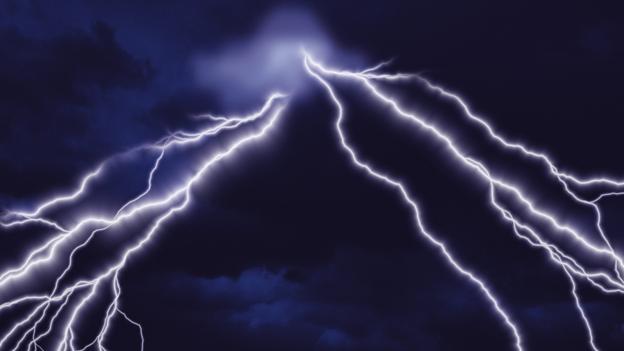
It seems hard to believe that we still don’t understand what causes lightning during thunderstorms – but that’s a fact.
Famously, Benjamin Franklin was one of the first people to investigate how lightning is triggered. He was correct to conclude that lightning is a natural electrical discharge – those were the early days of harnessing electricity – but it’s not clear that his celebrated kite-and-key experiment in 1752 ever went beyond a mere idea, not least because the kite was depicted, in Franklin’s account, as being flown – impossibly – out of a window.
In some ways we’ve not got much further since Franklin. It’s not yet agreed, for example, how a thundercloud gets charged up in the first place. Somehow the motions of air, cloud droplets, and precipitation (at that altitude, ice particles) conspire to separate positive from negative charge at the scale of individual molecules. It seems that ice particles acquire electrical charge as they collide, rather as rubbing can induce static electricity, and that somehow smaller ice particles tend to become positively charged while larger ones become negatively charged. As the small particles are carried upwards by convection currents, the larger ones sink under gravity, and so their opposite charges get separated, creating an electrical field.
A lightning strike discharges this field. It is basically a gigantic spark jumping between the “live wire” and the “earth” of an electrical circuit, in which the former is the charged cloud and the latter is literally the earth.

